
KNKE Large-Diameter Butterfly Valve for Water Systems
1. Product Structure and Fluid Control System Overview
In modern industrial pipeline networks and urban transmission systems, large-diameter imported butterfly valves serve as key devices for mainline shut-off and flow regulation. They do more than simple on-off control. They also affect system pressure distribution and overall fluid stability.
USA KNKE INDUSTRY INC designs and optimizes these valves for industrial fluid control systems. The company improves both structure and performance to support different pipe sizes and various media conditions. Engineers use a low-flow-resistance channel design. This design allows the medium to pass smoothly and reduces energy loss.
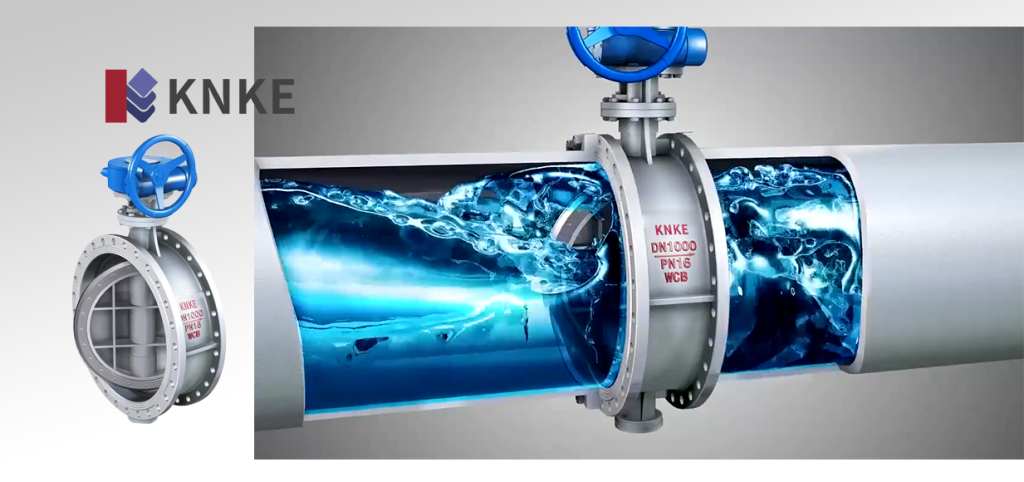
The valve structure includes four main parts: valve body, disc, shaft, and actuator. The disc rotates to control flow opening. As the disc moves from fully closed to fully open, the flow area changes gradually. This allows stable flow regulation.
This design is especially important in large-diameter pipelines. Sudden flow changes in such systems can affect overall stability.
2. Performance in Urban Water Supply and Long-Distance Transmission Systems
Urban water supply systems and cross-regional transmission projects usually use large-diameter pipelines. These pipelines are long and carry large volumes of water. As a result, the system requires stable and precise flow control.
Operators commonly install large-diameter butterfly valves at pump station outlets. They also use them for zone distribution control and main pipeline switching.
During operation, the valve adjusts its opening step by step. This helps keep water distribution balanced across the network. When pressure changes occur, the valve adjusts the flow area. This reduces the impact of pressure surges on the pipeline system.
In multi-pump station systems, the valve works with automated control systems. The system adjusts the valve based on regional demand. This process improves supply continuity and control accuracy.
3. Adaptability in Industrial Energy and Complex Media Conditions
Industries such as petrochemicals, metallurgy, power generation, and energy transport often handle complex media. These fluids may have temperature variations or contain small solid particles. Such conditions require strong valve adaptability.
In these environments, large-diameter butterfly valves control main pipelines. They also support emergency shut-off and bypass regulation.
As the fluid passes through the valve, the disc and body create a smooth flow path. This reduces strong turbulence and improves flow stability.
The actuator provides stable torque during operation. It drives the disc to rotate smoothly. This reduces mechanical shock during opening and closing.
The sealing system maintains stable contact over long operation periods. It helps the valve perform consistently under different working conditions.
In continuous production systems, the valve also connects with control systems. It manages flow transitions between process stages and improves process continuity.
4. Selection Complexity and System-Based Matching Approach
Engineering projects often face complex conditions when selecting large-diameter butterfly valves. Pipe sizes vary widely. Media conditions are not always consistent. Operating conditions may also change frequently.
Single-parameter selection methods cannot fully meet these requirements.
To solve this, 科恩科工业(深圳)有限公司 uses a system-based matching approach. The company integrates valve selection into the full fluid system design.
Engineers evaluate more than just valve size and pressure rating. They also analyze pipeline structure, flow variation range, and control frequency.
This multi-dimensional analysis helps ensure stable performance under different conditions.
In complex projects, the control system also coordinates valve movement. The system synchronizes valve opening with pump stations and regulation units. This reduces operational uncertainty and improves system stability.

5. Operational Coordination and Long-Term Service Support
In large industrial systems, butterfly valves are not isolated devices. They act as key nodes in the fluid control network. Their performance depends on upstream and downstream equipment.
During long-term operation, the valve works with actuators, sensors, and control units. This cooperation ensures stable and continuous flow regulation.
In continuous systems, operators record valve opening data regularly. These records help analyze system trends and operating conditions.
Maintenance teams also monitor valve performance over time. They evaluate usage cycles and adjust maintenance plans accordingly. This helps reduce unexpected shutdowns.
KNKE builds a full lifecycle service system. It supports customers from early system design to long-term operation. This approach helps large-diameter butterfly valves operate reliably in complex industrial environments and maintain stable system performance.