
Imported Target Flow Meter for Lithium Battery Slurry: KNKE Applications
An imported target flow meter measures fluid flow by detecting the force exerted on a target plate. In lithium battery production, it may help monitor certain industrial liquids and slurry-related processes. Its suitability depends on viscosity, particle content, flow conditions, and instrument design. American KNKE offers fluid control products, including flow meters, valves, pumps, and actuators, for industrial measurement and control applications.
1. Flow Monitoring in Lithium Battery Material Production
Lithium battery manufacturing involves material mixing, slurry preparation, transportation, and coating. Changes in slurry flow can affect material feeding and process control. Slurry may have high viscosity and contain solid particles. Engineers must therefore consider fluid properties, pipeline conditions, and measurement methods when selecting a flow meter.
An imported target flow meter measures the force that a fluid exerts on a target plate. Sensors and signal processing circuits convert this force into flow data. The instrument may suit certain liquids and viscous industrial fluids. However, engineers must assess particle size, viscosity, flow velocity, and target plate design before using it for a specific lithium battery slurry.
For example, a production line may transfer slurry from a storage tank to downstream equipment. Engineers can install a suitable target flow meter in a section of the pipeline after evaluating the operating conditions. Operators can then monitor instantaneous flow, cumulative flow, and pump status. These readings help them assess material feeding and provide data for process adjustments.
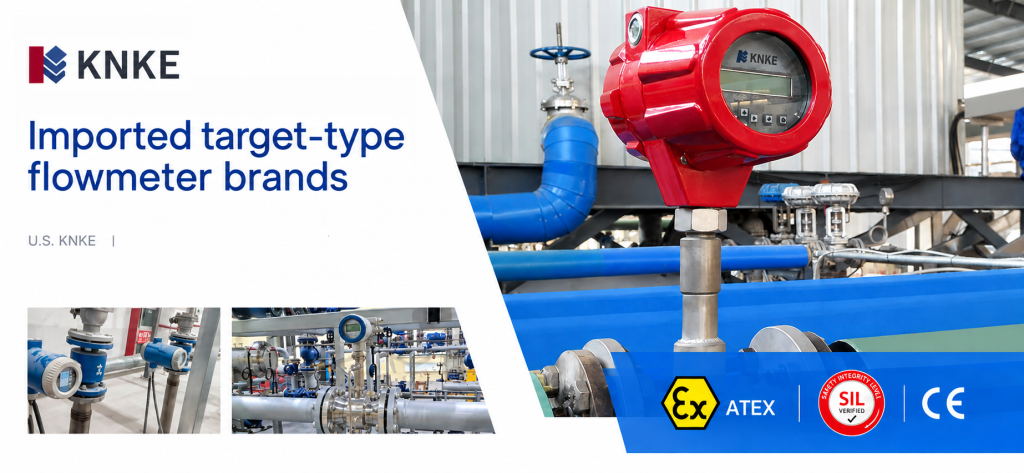
2. Measurement Principle and Technical Parameters
An imported target flow meter converts the force acting on its target plate into flow data. Fluid density, flow velocity, target plate design, and calibration all affect its output. Different fluids and pipe sizes may therefore require different measurement settings.
Some publicly available product specifications list a turndown ratio of approximately 1:30 for certain target flow meters. Some models also state an accuracy of ±0.2%. These figures apply only to the relevant products. They do not represent guaranteed performance for every American KNKE model.
Key Factors for Slurry Measurement
Lithium battery slurry may contain solid particles that affect measurement stability. Particle buildup can change the flow field, while abrasive particles may wear the target plate. Engineers should check these risks before selecting an instrument.
The selection process should focus on actual operating conditions rather than the product name or a single accuracy figure. If the slurry has a high solids content, engineers may need to compare other measurement technologies.
3. Instrument Selection and Installation
Pipeline conditions play an important role in flow meter performance. Different fluids may have different viscosities, temperatures, and flow ranges. An unsuitable measuring range or poor installation can affect measurement stability.
Before selecting an imported target flow meter, engineers should confirm the following details:
- Fluid properties: Identify the composition, viscosity, density, particle characteristics, and expected flow range.
- Pipeline conditions: Confirm the nominal pipe size, operating pressure, temperature, connection type, and available space.
- Signal requirements: Check whether the control system needs instantaneous flow, cumulative flow, analog output, or digital communication.
- Maintenance needs: Assess the risk of particle buildup, target plate wear, and difficult inspection access.
Some published target flow meter specifications list pipe sizes from DN15 to DN300. They may also offer 4–20 mA, pulse, or RS485 outputs. These are examples of industry configurations, not confirmed specifications for every KNKE product.
Example of Industrial Application
Suppose a lithium battery facility needs to monitor an auxiliary liquid. Engineers can first review pump operating conditions and pipeline parameters. They can then determine the required measuring range and check material compatibility.
After installation, the control system can use the flow signal to track changes in liquid supply. Operators may use this information when adjusting pump speed or valve opening. For slurry with high solids content, engineers should also evaluate target plate loading, particle buildup, and wear. Depending on the application, they may compare electromagnetic or Coriolis mass flow meters.
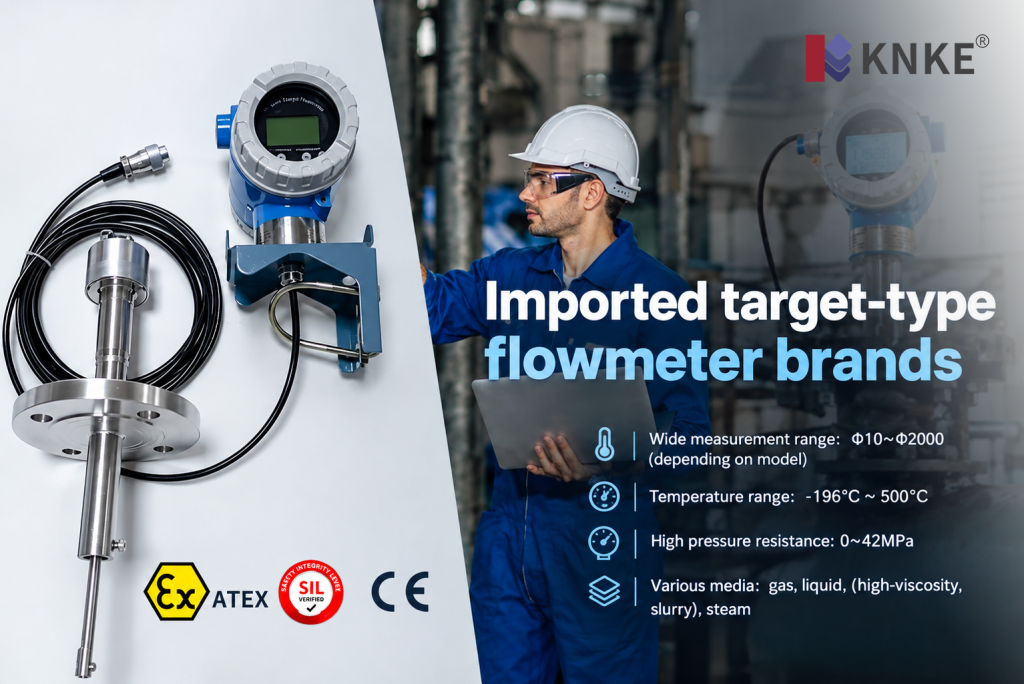
4. KNKE Products and Project Coordination
Lithium battery equipment projects may include transfer pumps, control valves, flow meters, actuators, and automation systems. Engineers must consider measurement performance, signal interfaces, installation conditions, and technical documentation when selecting instruments.
According to information published on the KNKE website, KNKE Industrial (Shenzhen) Co., Ltd. is a wholly owned subsidiary established in China by American KNKE. The company handles sales and services in the Asia-Pacific market. KNKE INDUSTRY INC is headquartered in Colorado, USA, and offers fluid control products such as valves, flow meters, pumps, and actuators.
Technical and Delivery Considerations
Project teams should confirm the fluid, measuring range, pressure, temperature, connection type, and signal interfaces before finalizing a model. They should also check product materials and applicable inspection documents.
During delivery and commissioning, teams should keep wiring diagrams, instrument settings, installation records, and test documents. These records help technicians troubleshoot problems and maintain equipment later.
The final product configuration should match the project’s technical requirements. Delivery schedules and service arrangements should follow the terms confirmed by the relevant parties.
5. Applications in Lithium Battery Production
Automation and data management continue to play important roles in lithium battery manufacturing. Flow monitoring can support slurry feeding, auxiliary fluid transfer, and other suitable pipeline processes.
An imported target flow meter measures the force that a fluid exerts on a target plate. It may serve as an option for certain industrial fluids when the medium and installation conditions meet the instrument’s requirements. However, lithium battery slurries differ in composition, viscosity, particle concentration, and flow behavior. A description such as “suitable for viscous media” does not mean that every slurry is compatible with the instrument.
How to Choose a Suitable Flow Meter
Applications that require direct mass flow or density measurement may need a different measurement principle. High-solids-content slurry may also require a detailed assessment of alternative technologies.
American KNKE offers flow meters, valves, pumps, and actuators for industrial fluid control. For a lithium battery production line, engineers should first identify the fluid properties, flow range, operating pressure, temperature, and installation conditions. They should then verify the measurement principle, measuring range, output signals, and maintenance requirements of the selected model.
With proper evaluation and installation, an imported target flow meter may support flow monitoring in suitable lithium battery production processes. Its readings can help operators manage material feeding and provide data for automated control.