
Imported Mass Flow Meter Selection | USA KNKE Solution
Why Industrial Sites Need an Imported Mass Flow Meter for Complex Fluid Measurement
In chemical processing, new materials, pharmaceuticals, energy, and precision manufacturing, an Imported Mass Flow Meter is more than a device for checking fluid flow. It provides direct mass measurement data for raw material mixing, continuous reactions, and energy management processes. For many industrial applications, companies need to know how much material actually enters the production system rather than only measuring the fluid volume.
An imported mass flow meter is designed for processes where mass measurement plays an important role. Unlike traditional volume flow meters, it directly measures mass flow and reduces the need for additional calculations based on density, temperature, and pressure changes.
Many companies face difficulties when selecting flow instruments. Site conditions are often complex, and basic product information may not show whether a model fits the actual application. Different models also require different choices in pipe size, material, pressure rating, and measurement range. After installation, limited technical support may create problems with communication settings, parameter adjustment, and system commissioning.
USA KNKE INDUSTRY INC is headquartered in Colorado, USA. The company provides fluid control products and solutions, including valves, flow meters, pumps, and actuators. KNKE Industrial (Shenzhen) Co., Ltd. is the wholly-owned holding company established in China by USA KNKE INDUSTRY INC. It is responsible for sales support and technical services in the Asia-Pacific market.
An imported mass flow meter uses the Coriolis measurement principle. When fluid passes through a vibrating measurement tube, the tube generates a phase difference related to mass flow. Sensors collect the signal, and the converter calculates the mass flow value. The instrument can also measure additional process data such as fluid density and temperature.
In industrial applications, Coriolis mass flow meters commonly provide liquid mass flow accuracy of around ±0.1% to ±0.2%. Density measurement capability can reach approximately 0.0005 g/cm³. Compared with traditional volume measurement methods, an Imported Mass Flow Meter provides direct mass data, making it suitable for batching, material control, and process monitoring.
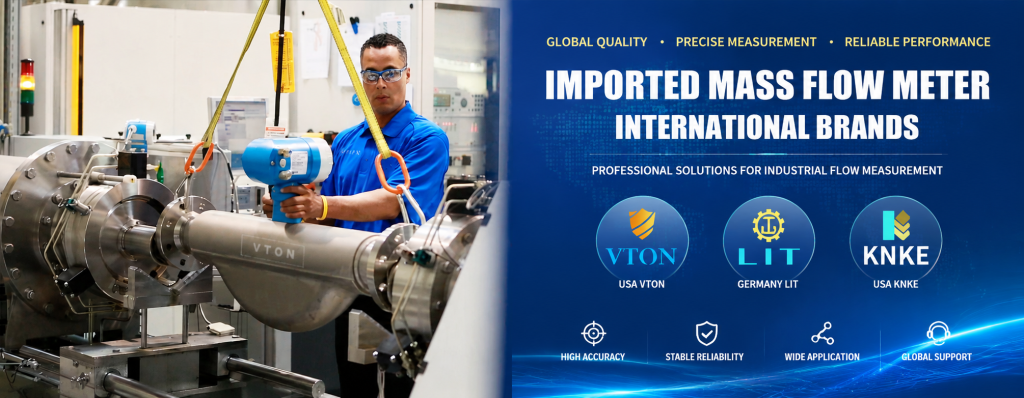
Key Parameters for Selecting an Imported Mass Flow Meter
For industrial users, the main challenge is not purchasing an instrument. The important step is selecting a model that matches the actual operating conditions.
For example, a chemical raw material pipeline may transport resin, solvents, additives, or other process fluids. These materials may have different densities, viscosities, and temperature characteristics. Selecting a flow meter only according to pipeline size may not provide suitable measurement performance.
Before choosing an Imported Mass Flow Meter, engineers usually check several important parameters.
Medium Characteristics
The first step is understanding the fluid type. Users need to confirm whether the medium is liquid, gas, or a mixed fluid. They should also consider corrosion, viscosity, adhesion, and possible solid particles.
Different fluids require different materials and configurations. For example, chemical liquids may require corrosion-resistant materials, while food or pharmaceutical applications may focus on cleaning requirements and hygienic connections.
Flow Range
The normal flow rate, maximum flow rate, and minimum flow rate are important selection factors.
If the selected measurement range is too large, the instrument may not perform well during low-flow operation. If the range is too small, the device may not handle peak operating conditions.
A suitable flow range allows the meter to work properly throughout the production process.
Temperature and Pressure Conditions
Industrial environments can include normal temperature conditions, high-temperature processes, and pressure-controlled pipelines.
The selected Imported Mass Flow Meter should match the actual temperature and pressure requirements. Incorrect selection may affect installation, operation, and long-term use.
Connection Type and Material
Common connection methods include flange and threaded connections. The measurement tube material should match the characteristics of the fluid.
Stainless steel materials are widely used in many industrial liquid applications because they provide suitable compatibility for common process environments.
During the application process, USA KNKE communicates with users about medium type, flow parameters, pressure, temperature, and installation conditions. This approach helps reduce selection errors caused by incomplete information.
For industrial instruments, correct selection is more important than comparing specifications alone. A suitable Imported Mass Flow Meter can provide more reliable support for long-term process management.
Imported Mass Flow Meter Applications in New Material Production
In new material manufacturing, some reaction processes require continuous feeding of liquid raw materials. The ratio of each material directly affects the following production steps. Therefore, production systems need real-time information about the actual amount of material entering the equipment.
A new material production line may transport liquid raw materials with certain viscosity. Environmental temperature changes can also influence fluid density. Traditional volume flow measurement methods require additional compensation calculations when density changes. Production operators often prefer direct mass flow data.
In this type of application, the Imported Mass Flow Meter is installed on the material pipeline. The meter detects vibration changes caused by fluid movement and sends mass flow signals to the control system.
The control system uses these signals to monitor the feeding process and works with control valves and transfer pumps to adjust operation conditions.
During continuous reactor feeding, mass flow data helps operators evaluate:
- Whether the current material supply reaches the required setting;
- Whether abnormal flow changes appear during transportation;
- Whether material input remains consistent between production batches.
For continuous production companies, a flow meter provides more than a displayed value. It becomes an important data source for production control.
The application value of an Imported Mass Flow Meter in chemical, new material, and pharmaceutical industries mainly comes from reducing manual calculations, improving process visibility, and supporting automated management.
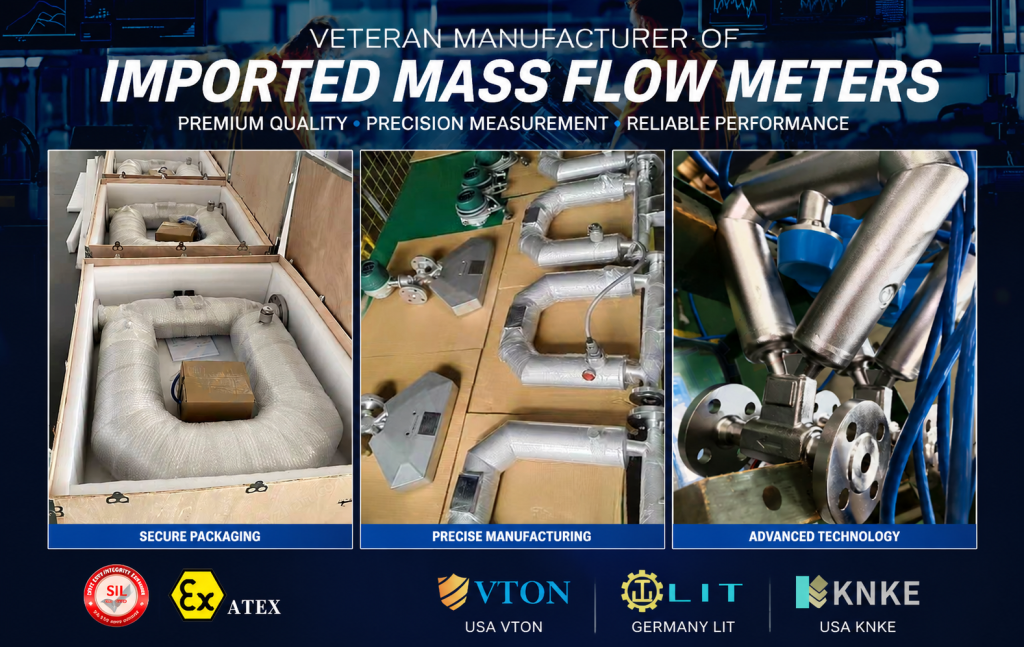
Product Quality and Service Support Affect Long-Term Use
When companies select industrial equipment, they consider more than the instrument itself. They also pay attention to product reliability, delivery coordination, and technical support.
Some users may experience problems with imported equipment, such as incomplete documents, unclear model confirmation, or limited installation communication. These issues may not appear in product specifications, but they can affect project progress.
An Imported Mass Flow Meter includes sensor components, electronic converter modules, and mechanical structures. During long-term operation, the equipment may face temperature changes, vibration, electromagnetic interference, and different fluid conditions.
Therefore, the design needs to consider industrial application environments.
USA KNKE focuses on fluid control solutions and provides products such as flow meters, valves, pumps, and actuators. For projects that require both measurement and control equipment, users can consider the complete fluid system when selecting products.
Industrial users usually focus on several service factors:
- Complete technical documents;
- Clear parameter confirmation;
- Technical communication during installation and commissioning;
- Support during later operation.
Compared with simply providing product models, a complete technical communication process helps users confirm application conditions before installation and reduces future adjustment work.
For industrial projects, the equipment supplier’s technical support ability is also an important part of the overall application process.
Imported Mass Flow Meter Supports Digital Manufacturing Development
With the development of automated production, companies require more process data for management and control. Flow information is no longer only a display value. It has become an important input for PLC and DCS systems.
An Imported Mass Flow Meter usually supports industrial communication methods such as 4-20mA, RS485, and HART. These communication options allow the instrument to transmit flow, density, and temperature data to control systems.
Different industries use mass flow meters in different ways.
Chemical companies use them for raw material delivery and ratio control. Pharmaceutical manufacturers apply them for solvent and auxiliary material measurement. Energy management systems use them for liquid or gas consumption monitoring. Food producers use them for ingredient management.
For companies, selecting an Imported Mass Flow Meter requires more than understanding the measurement principle. They also need to evaluate whether the product matches their production environment.
USA KNKE provides support from product selection to application communication through its fluid control product system and Asia-Pacific service team.
Facing industrial users’ concerns about selection difficulties, product quality, delivery coordination, and after-sales support, the value of an Imported Mass Flow Meter is not only reflected in measurement data. It also supports production process management, automation control, and long-term industrial operation.