
KNKE Imported Concentration Meter: What Are Its Advantages?
The KNKE imported concentration meter measures liquid concentration, density, and other physical properties online. It can serve chemical plants, new energy material factories, water treatment systems, food processing lines, and industrial mixing units. First, the instrument tracks concentration changes without frequent manual sampling. Next, it sends measurement data to a PLC or DCS. Therefore, the control system can compare the data with process limits and adjust valves or pumps. In addition, KNKE offers several measurement methods for different liquids. These methods include density, sound velocity, conductivity, and refractive measurement. Temperature correction also helps reduce the effect of process temperature changes. As a result, the instrument can support continuous monitoring and process control.
Continuous Monitoring with the KNKE Imported Concentration Meter
Traditional laboratory testing often includes sampling, transport, analysis, and manual data entry. As a result, operators may wait several minutes or several hours for one result. However, the liquid concentration inside the pipeline may change during this period. This delay can affect mixing, reaction control, washing, separation, and material transfer.
In contrast, the KNKE imported concentration meter provides regular online readings. Engineers can install it in a process pipeline, a tank circulation line, or a bypass measuring unit. Depending on the model, the instrument can update the concentration value every few seconds. Therefore, operators can view the process trend more quickly.
The instrument can send concentration data to a PLC, DCS, recorder, or control cabinet. Then, the control system can compare the reading with preset limits. If the concentration moves outside the target range, the system can adjust a stock solution valve or a dilution water valve. It can also start an alarm.
For example, a liquid mixing system may need to keep concentration between two set limits. The concentration meter monitors the circulating liquid. Meanwhile, the PLC receives the signal and controls the relevant valve. This arrangement creates a simple monitoring and adjustment loop.
Depending on the medium, common measurement ranges may cover approximately 0% to 100%. However, engineers should select the actual range according to the liquid and measurement method. A narrower working range may provide better resolution for some applications.
Furthermore, users can choose 4–20 mA, RS485, pulse, or other industrial communication outputs. They can also select IP65 or IP67 protection for dusty or humid areas. Therefore, the instrument can work with many industrial control systems and installation environments.
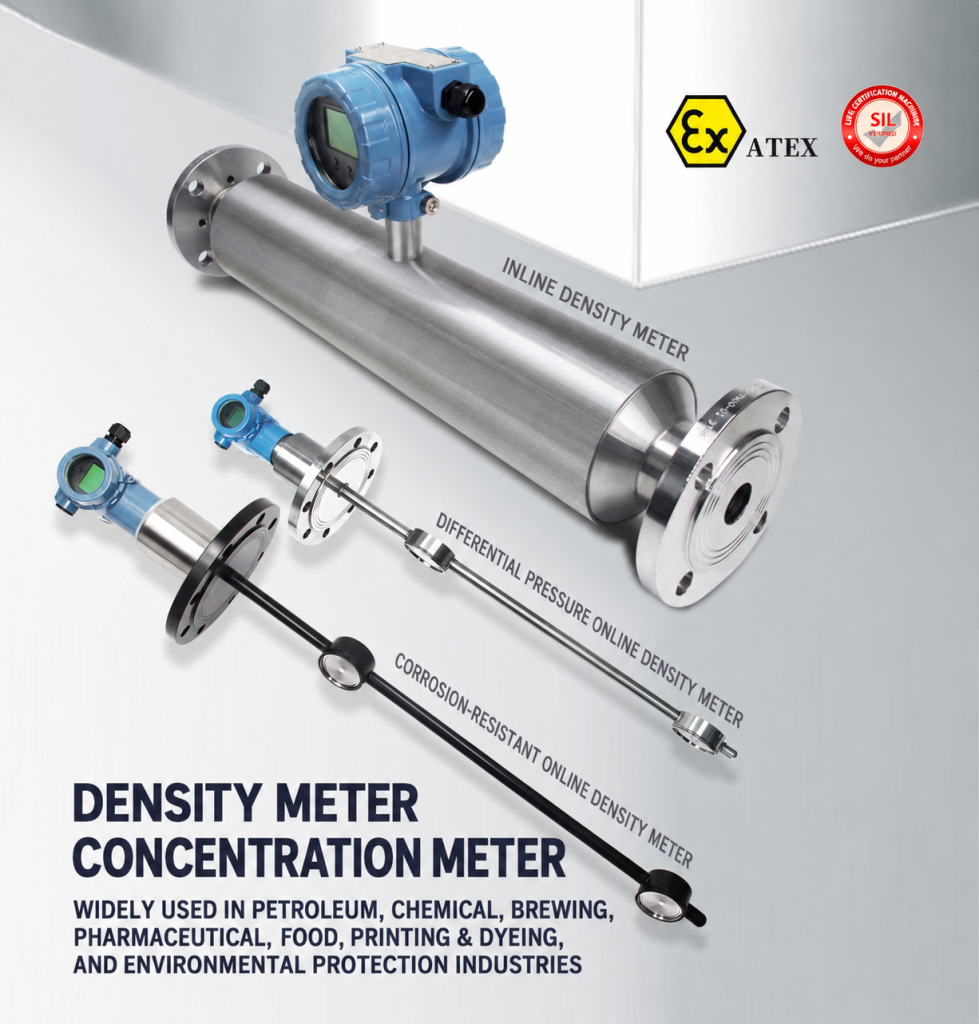
Main Data for Instrument Selection
Users should not select a concentration meter by measurement range alone. Different liquids may have the same concentration but show different density, conductivity, sound velocity, or refractive values. Therefore, engineers must match the measurement method to the actual medium.
For example, a new energy material mixing system in South China requires continuous concentration monitoring. The proposed liquid concentration ranges from about 10% to 60%. The normal temperature ranges from about 20°C to 80°C. Meanwhile, the design pressure remains below 1.6 MPa.
In this system, the KNKE imported concentration meter monitors liquid in the circulation pipeline. It then sends the concentration signal to the control cabinet. Next, the PLC compares the value with the target range. Finally, the PLC can adjust the stock solution valve or dilution water valve.
Before selecting a model, users should provide the following information:
- Medium name, main ingredients, and target concentration;
- Normal temperature and maximum design temperature;
- Working pressure and expected flow velocity;
- Liquid viscosity and corrosive properties;
- Bubble, particle, crystal, and deposit conditions;
- Pipe size, connection type, and installation space;
- Power supply, output signal, and communication needs.
After receiving this information, the technical team can compare suitable measurement methods. For corrosive liquids, users may choose 316L stainless steel, Hastelloy, titanium, or a fluoropolymer-lined structure. However, engineers should check the actual chemical compatibility before confirming the material.
For thick liquids, a removable sensor may simplify cleaning. Likewise, a bypass measuring unit may suit systems that need regular inspection. As a result, users can maintain the instrument without stopping the main pipeline for a long period.
These figures describe normal design conditions and project planning data. Therefore, the final model should follow the actual medium, temperature, pressure, and installation requirements.
Stable Measurement Through Correct Installation
Instrument quality affects measurement, but installation conditions also play an important role. For example, strong flow pulses may cause the reading to change quickly. Air bubbles can affect density or sound velocity measurement. In addition, deposits on the sensor may change its response.
A pump outlet often produces strong flow pulses. Therefore, engineers should avoid installing the sensor too close to the pump when possible. Pipeline high points may also collect air. As a result, the measuring section may not remain full of liquid.
For a fine chemical mixing system, the proposed design places the concentration meter in a stable section of the circulation line. Engineers also add isolation valves before and after the instrument. In addition, they include a flushing connection for cleaning.
The proposed liquid velocity ranges from about 0.5 to 3 metres per second. This range can help the liquid move evenly across the sensor. However, the final velocity depends on the sensor design, pipe size, and liquid viscosity.
Temperature also changes many liquid properties. Therefore, the KNKE imported concentration meter can use an integrated temperature sensor. The instrument uses the temperature value to correct the concentration calculation. However, temperature correction cannot solve every process problem. The selected calculation curve must still match the liquid formula.
The instrument can update the signal within one to several seconds, depending on the configuration. Fast updates help the system identify process changes. However, very fast signals may cause frequent valve movement. Therefore, engineers can add suitable signal damping.
The proposed PLC logic uses upper and lower concentration limits. First, the PLC receives the concentration signal. Next, it compares the value with the target range. Then, it adjusts the stock solution or dilution valve. This design links measurement, flow control, and valve action. Still, these values remain design references rather than confirmed operating results.
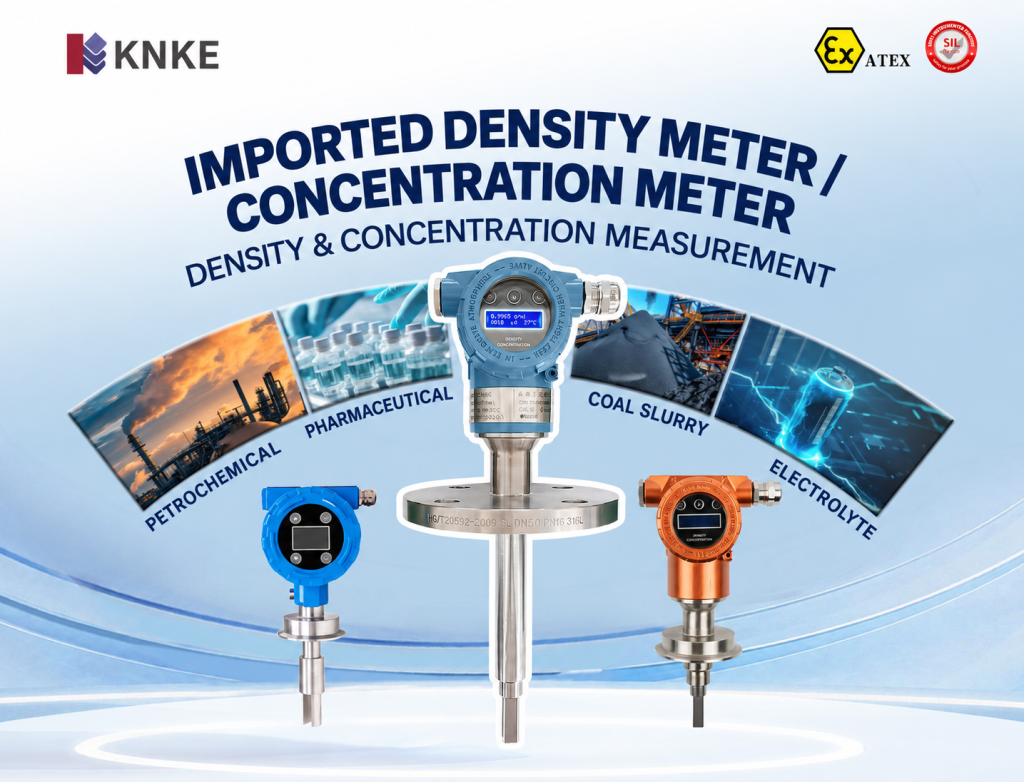
Local Support for Project Coordination
Imported instruments often require several rounds of technical confirmation. For example, users need to confirm the material, connection, signal output, and communication method. Different document versions can create confusion. Therefore, a clear coordination process can reduce repeated work.
KNKE Industry (Shenzhen) Co., Ltd. serves the Asia-Pacific market as the wholly owned Chinese company of USA KNKE INDUSTRY INC. The local team supports product selection, document checks, delivery coordination, and technical communication.
USA KNKE INDUSTRY INC operates from its headquarters in Colorado, United States. The company provides valves, flowmeters, pumps, electric actuators, pneumatic actuators, and fluid control solutions. Therefore, the team can review both the measuring instrument and the related control loop.
For each KNKE imported concentration meter project, the team can use the following document controls:
- Match one process data sheet with one equipment tag;
- Record the range, material, connection, and signal type together;
- Check the medium before recommending the measuring method;
- Review special materials and custom connections separately;
- Confirm the nameplate, power supply, and output before delivery;
- Keep one current version of each technical document.
When users provide complete process data, the team may prepare an initial selection suggestion within one to three working days. However, special liquids may need more evaluation. For example, a new liquid formula may require sample analysis or a separate concentration curve.
In addition, local coordination reduces communication across different time zones. It also gives users a clear contact point for technical and project information. As a result, users can reduce repeated confirmation and missing information.
Installation, Maintenance, and Technical Service
Correct installation helps the instrument produce useful process data. First, the sensor should remain in full contact with the liquid. Next, the measuring point should avoid trapped air and stagnant flow. Finally, users should check the sensor for deposits during routine maintenance.
Liquids that crystallize or form deposits need regular cleaning. Therefore, engineers should reserve a flushing connection or choose a removable sensor. The cleaning interval depends on the liquid and production schedule.
When the factory changes the liquid formula, operators should review the concentration curve. A curve for one formula may not suit another formula. Likewise, users should check the temperature correction range after a major process change.
If the reading becomes unusual, users can provide the equipment tag, alarm code, trend data, and installation photographs. They should also provide the current medium, temperature, and pressure. Then, the technical team can check possible causes more quickly.
For example, the team may first check for sensor deposits. Next, it may review bubble conditions and flow changes. After that, it can check signal settings and PLC logic. This process helps separate instrument issues from process changes.
The KNKE imported concentration meter can work with flowmeters, control valves, dosing pumps, and control systems. KNKE also supplies butterfly valves, ball valves, solenoid valves, regulating valves, actuators, and industrial pumps. Therefore, the team can review measurement, transport, and adjustment as one process.
Overall, KNKE starts with process data and continues through model selection, installation, and maintenance support. This approach addresses common concerns about difficult selection, unstable readings, slow coordination, complex documents, and limited service. As a result, users can build a clearer and more practical online concentration monitoring plan.