
Coriolis Mass Flowmeter: KNKE Lithium Dosing Guide
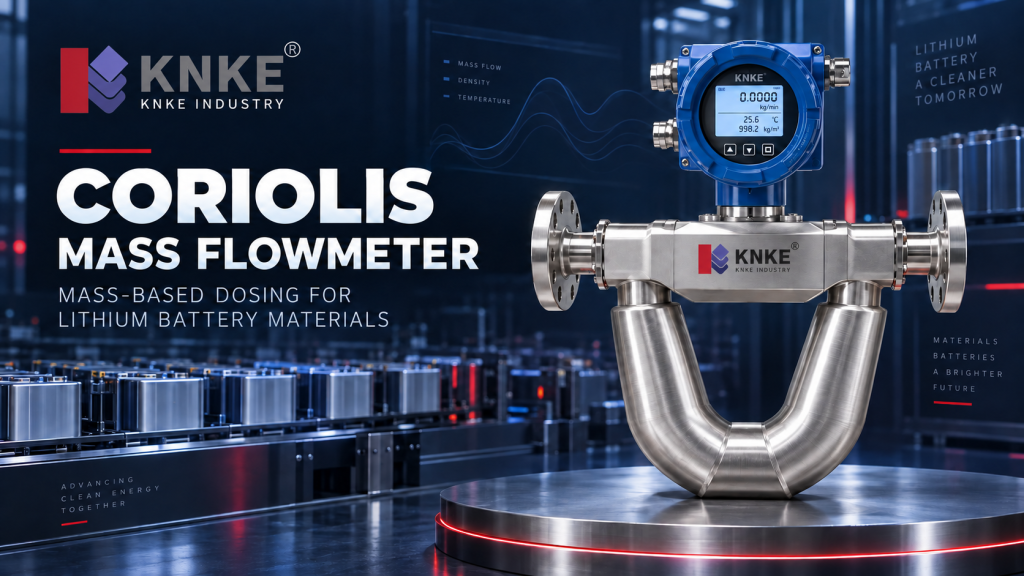
A Coriolis mass flowmeter measures material by mass instead of volume. This method supports electrolyte and cathode material dosing in lithium battery production. USA KNKE offers imported Coriolis meters for solvents, lithium salt solutions, and liquid additives. The meter can provide mass flow, total mass, density, and temperature data. These values help the control system manage each dosing batch.
Coriolis Mass Flowmeter in Lithium Battery Dosing
Lithium battery electrolyte production requires controlled dosing of solvents, lithium salt solutions, and additives. Fluid density may change with temperature and concentration. A volume-based system may deliver a different material mass when density changes.
A KNKE imported Coriolis mass flowmeter detects changes in the vibration of its measuring tubes. The transmitter converts these changes into a mass flow value. The meter can also monitor fluid density and temperature.
One electrolyte preparation system uses fluid with a density of about 1,200 kg/m³. Its operating temperature ranges from 20°C to 35°C. Temperature changes may alter the fluid volume. However, mass-based measurement provides a clearer basis for formulation control.
The meter usually contains no rotating impeller. This structure reduces the number of moving parts in contact with the fluid. Engineers must still consider air bubbles, pipeline vibration, installation stress, and zero-point conditions.
Electrolyte Additive Dosing Design
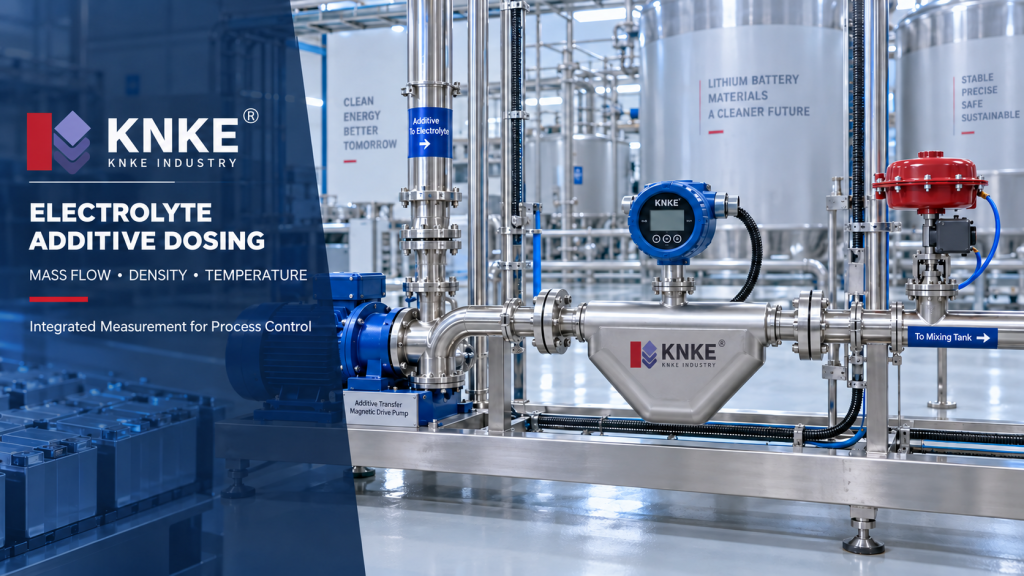
A lithium battery material project plans an electrolyte additive preparation unit. The unit will transfer organic solvents and liquid additives. The control system needs to manage each batch through accumulated mass.
The proposed system uses a USA KNKE imported Coriolis mass flowmeter. A magnetic drive pump supplies the liquid. A control valve adjusts the feed rate. A pneumatic shut-off valve stops the flow at the target value.
The main design data include:
- Mass flow range: about 80–600 kg/h
- Normal flow rate: about 300 kg/h
- Planned batch quantity: about 500 kg
- Fluid density: about 1,200 kg/m³
- Operating temperature: about 20–35°C
- Pipeline design pressure: about 0.6 MPa
The controller reads the accumulated mass during dosing. It reduces the flow rate when the batch approaches its target. The controller then closes the shut-off valve at the preset value.
The system must also consider valve closing time. Liquid may continue to move after the controller sends the closing signal. Engineers should include this remaining material in the dosing calculation.
The project remains at the technical review and quotation stage. These figures explain the proposed design method. They do not represent actual operating results.
Meter Range and Pressure Loss
Engineers should select a Coriolis mass flowmeter according to mass flow and fluid properties. They must review density, viscosity, pressure, temperature, and allowable pressure loss. Pipeline size alone cannot determine the correct meter size.
A mass flow of 300 kg/h equals about 0.25 m³/h at a density of 1,200 kg/m³. When mass flow reaches 600 kg/h, the volume flow rises to about 0.50 m³/h. Engineers can use these figures to check velocity and pressure loss inside the measuring tubes.
An oversized meter may operate near the bottom of its range. This condition may reduce low-flow resolution. An undersized meter may create excessive pressure loss. It may also affect the pump and control valve.
If the project requires a system error within ±0.2%, engineers must examine several factors. They should check meter accuracy, repeatability, zero stability, and turndown ratio. They should also consider valve response and residual liquid in the pipe.
Volatile liquids require additional attention. The measuring tubes should remain full during operation. The system should maintain enough back pressure to limit gas formation. The confirmed model and operating conditions determine the final performance.
Solutions for Common Project Challenges
Lithium battery projects often face incomplete process data and unclear equipment configurations. Delivery coordination may also create delays. Complex documents and limited technical support can increase project workload.
KNKE Industrial (Shenzhen) Co., Ltd. supports USA KNKE sales and service across the Asia-Pacific market. Its technical process addresses several common concerns:
- For difficult selection, engineers review fluid composition, density, viscosity, flow, pressure, and temperature.
- For configuration control, documents list tube materials, process connections, signals, power supply, and protection requirements.
- For delivery coordination, the project follows model approval, production planning, documentation, and shipment stages.
- For settlement documents, the regional company coordinates contract files and technical records.
- For technical support, engineers review zero-point, flow, density, temperature, and alarm data.
For example, the meter may display flow when the liquid remains stationary. Engineers should first check whether the valves close fully. They should then inspect pipeline vibration and the filled condition of the measuring tubes.
Air bubbles may cause changes in flow and density readings at the same time. Comparing these values helps engineers identify process or installation problems. This method also reduces unnecessary instrument replacement.
KNKE Coriolis Mass Flowmeter Selection
USA KNKE INDUSTRY INC operates from Colorado, USA. The company provides valves, flowmeters, pumps, actuators, and fluid control solutions. KNKE Industrial (Shenzhen) Co., Ltd. supports the Asia-Pacific market.
A KNKE Coriolis mass flowmeter can work with control valves, pneumatic ball valves, magnetic drive pumps, and plant control systems. These components form a mass-based dosing unit for lithium battery materials.
Customers should provide three flow conditions before selection. These include minimum, normal, and maximum mass flow. They should also provide the following information:
- Fluid composition and concentration
- Density and viscosity range
- Operating temperature
- Pipeline pressure
- Allowable pressure loss
- Planned batch quantity
- Required output signal
- Installation environment
Installers should avoid placing mechanical stress on the meter body. They should keep the meter away from strong, continuous vibration. The installation direction should match the fluid state and process requirements.
Engineers should also review the pump inlet and pipeline venting. These checks help reduce air bubbles in the liquid. Suitable back pressure can further support a stable filled-pipe condition.
Early flow calculations help reduce range selection errors. Material checks support chemical compatibility. Installation reviews can reduce vibration and gas interference.
The USA KNKE imported Coriolis mass flowmeter provides mass-based measurement for electrolyte and battery material dosing. Each project still requires detailed parameter confirmation.