
Pipeline Flow Meter: A Key Device for Accurate Flow Measurement and Energy Efficiency
In modern industrial production, the pipeline flow meter has become an indispensable instrument for fluid measurement and energy management. Whether in petrochemical plants, water treatment facilities, food and beverage production, or pharmaceutical manufacturing, accurate monitoring of liquid or gas flow directly affects production efficiency and operational safety. Based on industry experience and technical expertise, this article provides a comprehensive overview of the working principles, types, selection guidelines, and common applications of pipeline flow meters.
1. What Is a Pipeline Flow Meter?
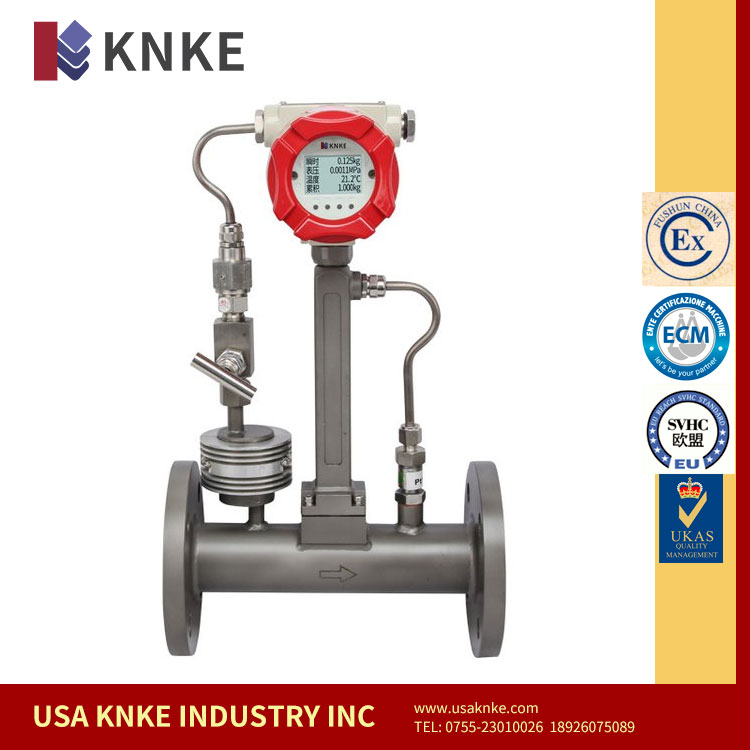
A pipeline flow meter is an instrument installed in a closed pipeline to measure the flow rate and total flow of fluids (liquids, gases, or steam) in real time. It converts the kinetic energy or volumetric change of the fluid into readable electrical signals through physical or electrical principles, enabling precise flow measurement and data transmission.
2. Working Principles of Pipeline Flow Meters
Depending on their measurement principles, the most common types of pipeline flow meters include:
Electromagnetic Flow Meter
- Principle: Based on Faraday’s law of electromagnetic induction—when a conductive liquid flows through a magnetic field, an induced electromotive force is generated.
- Advantages: No moving parts, high accuracy, suitable for wastewater and corrosive liquids.
- Limitations: Cannot measure non-conductive fluids such as oil or gas.
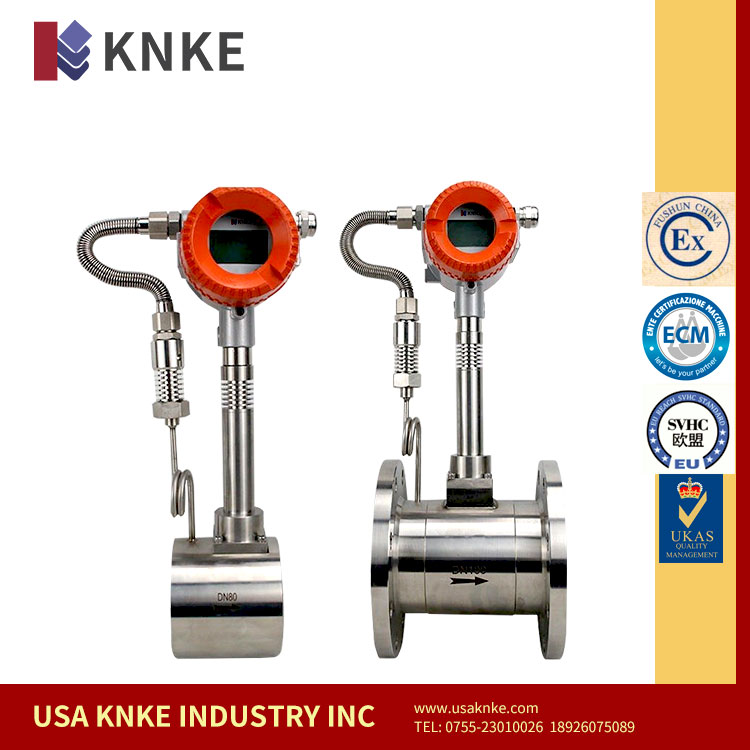
Vortex Flow Meter
- Principle: When a fluid passes an obstacle in the flow path, it generates alternating vortices. The vortex frequency is proportional to the flow velocity.
- Advantages: Simple structure, wide applicability, capable of measuring gases, liquids, and steam.
- Limitations: Sensitive to vibration; requires a stable flow field.
Ultrasonic Flow Meter
- Principle: Measures flow rate based on the time difference of ultrasonic waves or the Doppler effect.
- Advantages: Non-intrusive measurement, no pressure loss, flexible installation.
- Limitations: Sensitive to bubbles and suspended particles.
Differential Pressure (DP) Flow Meter
- Principle: Based on Bernoulli’s equation, the flow rate is calculated from the pressure difference before and after a restriction element.
- Advantages: Mature technology, relatively low cost.
- Limitations: Requires long straight pipe sections and regular maintenance.
3. Key Factors for Selecting a Pipeline Flow Meter
Drawing from extensive field experience, the following factors should be carefully considered during selection:
- Fluid properties: Conductivity, presence of impurities, temperature, and pressure.
- Pipe size and velocity range: Different meters perform optimally within specific velocity ranges.
- Installation environment: Check for space limitations or electromagnetic interference.
- Accuracy and budget: Higher precision and stability typically come with higher costs.
- Signal output and compatibility: Ensure integration with PLC, DCS, or remote monitoring systems.
✅ Expert Tip: For wastewater or chemical fluids, electromagnetic flow meters are recommended. For steam or high-temperature gases, vortex flow meters offer better reliability.
4. Application Fields of Pipeline Flow Meters
| Industry | Typical Applications | Recommended Meter Type |
|---|---|---|
| Municipal Water | Raw water transmission, wastewater treatment | Electromagnetic flow meter |
| Petrochemical | Chemical solutions, liquid fuels | Vortex or electromagnetic flow meter |
| Food & Beverage | Milk, beer, syrup | Sanitary electromagnetic flow meter |
| Energy Management | Steam flow, boiler monitoring | Vortex or differential pressure flow meter |
| HVAC | Chilled water, cooling water | Ultrasonic flow meter |
These applications are derived frSom industry standards and engineering practice, highlighting the technical suitability and reliability of various flow meter types.
5. Maintenance and Calibration
To ensure long-term accuracy and extend service life, follow these maintenance practices:
- Regular calibration: Recommended every 12 months for verification.
- Keep components clean: Especially electrodes and sensors, to prevent fouling or scaling.
- Check grounding and signal lines: Prevents electrical interference and measurement fluctuations.
- Recordkeeping: Maintain equipment logs with operational data and calibration records.
Professional maintenance significantly extends the service life of pipeline flow meters and reduces the likelihood of operational failures.
As a core instrument in industrial fluid monitoring, the pipeline flow meter plays a vital role in ensuring measurement accuracy and optimizing energy management. Proper selection and scientific application—based on process conditions, technical principles, and real-world experience—are essential for achieving efficient, reliable, and sustainable flow measurement.