
Vortex Flowmeter: Technical Principles, Structural Features, and Industrial Applications
A vortex flowmeter is a type of flow measurement instrument based on the Kármán vortex street principle. It is widely used for measuring the flow of steam, gases, and certain liquids in industrial pipelines. Due to its relatively simple structure and stable performance, vortex flowmeters are commonly applied in industries such as petrochemical, power generation, metallurgy, energy management, and heating systems.
With the advancement of industrial automation and digital instrumentation, vortex flowmeters have become important devices in modern process measurement systems. Their ability to operate under high temperature and high pressure conditions makes them particularly suitable for steam measurement, compressed air monitoring, and industrial gas metering.
2. Measurement Principle of Vortex Flowmeters
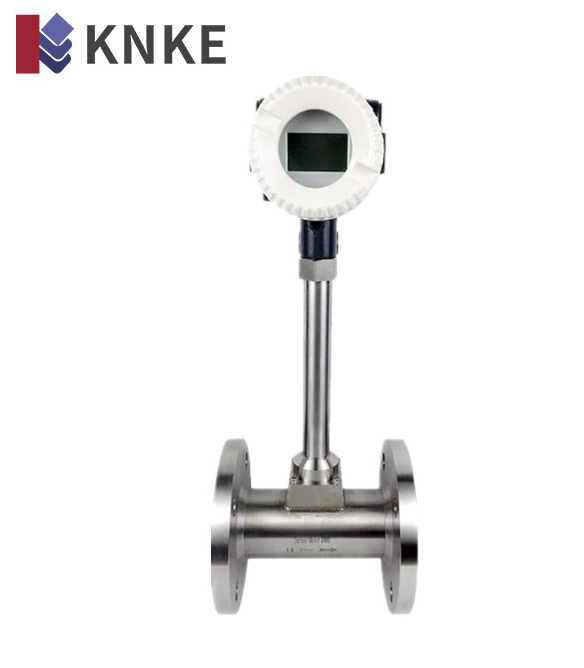
The operating principle of a vortex flowmeter is based on the Kármán vortex street phenomenon in fluid mechanics. When fluid flows past a bluff body (vortex generator) installed in the pipeline, alternating vortices are periodically generated downstream of the obstacle. This repeating pattern of vortices is known as a Kármán vortex street.
The frequency of vortex shedding is proportional to the velocity of the flowing fluid and can be expressed by the following equation:
f = St × V / d
Where:
- f — Vortex shedding frequency
- St — Strouhal number
- V — Average fluid velocity
- d — Characteristic width of the bluff body
Since the vortex frequency is directly proportional to the flow velocity, measuring the vortex frequency allows the instrument to calculate the volumetric flow rate.
Modern vortex flowmeters typically use sensors to detect pressure fluctuations or vibrations caused by vortex shedding. The detected signals are then converted into electrical signals for further processing and output.
3. Structural Components of a Vortex Flowmeter
A typical vortex flowmeter consists of several main components:
3.1 Bluff Body (Vortex Generator)
The bluff body is installed inside the pipe and is responsible for generating vortices as the fluid flows past it. The design of the bluff body directly influences measurement stability and sensitivity.
Common bluff body shapes include:
- Triangular prism structure
- Trapezoidal structure
- T-shaped structure
Different shapes are selected according to flow conditions and measurement requirements.
3.2 Sensor Assembly
The sensor detects pressure fluctuations or vibrations generated by vortex shedding and converts them into electrical signals. Common sensor types include:
- Piezoelectric sensors
- Capacitive sensors
- MEMS sensors
3.3 Signal Processing Unit
The signal processing unit amplifies, filters, and processes the sensor signals to generate standard industrial outputs, such as:
- 4–20 mA analog signal
- Pulse signal output
- HART communication
- Modbus or other digital communication protocols
3.4 Flowmeter Body
The meter body is typically manufactured using industrial-grade materials such as:
- Stainless steel
- Carbon steel
- Alloy steel
In high-temperature or corrosive environments, stainless steel or corrosion-resistant alloys are commonly used.
4. Key Technical Features of Vortex Flowmeters
4.1 Simple Structure and Low Maintenance
Vortex flowmeters contain no moving mechanical parts, which reduces wear and tear and minimizes maintenance requirements during long-term operation.
4.2 Suitable for Multiple Media
These flowmeters can measure various types of fluids, including:
- Steam
- Compressed air
- Industrial gases
- Certain liquid media
They are especially widely used for steam flow measurement in industrial facilities.
4.3 Wide Temperature and Pressure Range
Vortex flowmeters can operate reliably in high-temperature and high-pressure conditions, making them suitable for applications such as:
- Steam pipelines
- Boiler systems
- Energy management systems
4.4 Stable Signal Output
Advanced digital signal processing technology helps suppress noise interference, ensuring stable measurement signals and improved reliability.
4.5 Specific Installation Requirements
To maintain measurement accuracy, vortex flowmeters require adequate straight pipe lengths upstream and downstream of the installation point. Typical recommendations include:
- Upstream straight pipe length: 10D–20D
- Downstream straight pipe length: 5D–10D
Here, D represents the pipe diameter.
5. Typical Industrial Applications
5.1 Steam Measurement Systems
In industrial boilers, heating networks, and energy management systems, vortex flowmeters are commonly used for steam flow measurement, supporting energy monitoring and efficiency management.
5.2 Petrochemical Industry
In petrochemical plants, vortex flowmeters are applied for measuring:
- Industrial gases
- Process steam
- Process gases
Their high temperature resistance makes them suitable for demanding industrial environments.
5.3 Power Generation Industry
In thermal power plants and combined heat and power systems, accurate steam flow measurement is essential for operational efficiency and performance monitoring.
5.4 Compressed Air Systems
Compressed air is a critical energy source in industrial production. Vortex flowmeters help monitor compressed air consumption and detect inefficiencies.
5.5 Chemical Processing Industry
In chemical production processes, monitoring gas and steam flow is essential for maintaining stable process control and production safety.
6. Development Trends of Vortex Flowmeters
With the advancement of industrial technology, vortex flowmeters continue to evolve in several key directions:
6.1 Digitalization and Smart Instrumentation
Modern vortex flowmeters increasingly integrate digital communication and intelligent diagnostic functions.
6.2 Remote Monitoring and Industrial IoT
Integration with Industrial Internet of Things (IIoT) platforms allows remote monitoring, data acquisition, and predictive maintenance.
6.3 Advanced Sensor Technology
New generations of vortex flowmeters utilize improved sensor technologies, including MEMS-based sensors, to enhance detection sensitivity.
6.4 Multi-Parameter Measurement
Some advanced instruments can measure multiple parameters simultaneously, such as flow rate, temperature, and pressure, providing more comprehensive process data.
7. Conclusion
Vortex flowmeters represent a mature and widely adopted flow measurement technology. Based on the Kármán vortex principle, they measure flow by detecting the frequency of vortex shedding generated by fluid passing a bluff body.
Thanks to their stable structure, adaptability to high temperature environments, and reliable measurement performance, vortex flowmeters are widely used in steam measurement, industrial gas monitoring, and energy management systems.
As industrial automation and digital technologies continue to develop, vortex flowmeters are expected to further evolve toward smart, connected, and high-precision measurement solutions, providing reliable data support for modern industrial process control and energy management.