
Basic Principle and Structural Characteristics of Pilot-Operated Solenoid Valves
A pilot-operated solenoid valve controls fluid flow by combining electromagnetic control with pressure differential actuation. Unlike direct-acting solenoid valves, this type of valve does not rely on electromagnetic force to move the main valve directly. Instead, the solenoid actuates a pilot valve first, and the resulting pressure difference drives the main valve to open or close.
As a result, pilot-operated solenoid valves offer compact size, low power consumption, and cost efficiency. Moreover, they support a wide range of nominal diameters. For these reasons, engineers widely use them in industrial automation, pneumatic systems, and hydraulic control applications, especially in systems that require large flow rates or higher operating pressures.
1. Structural Composition
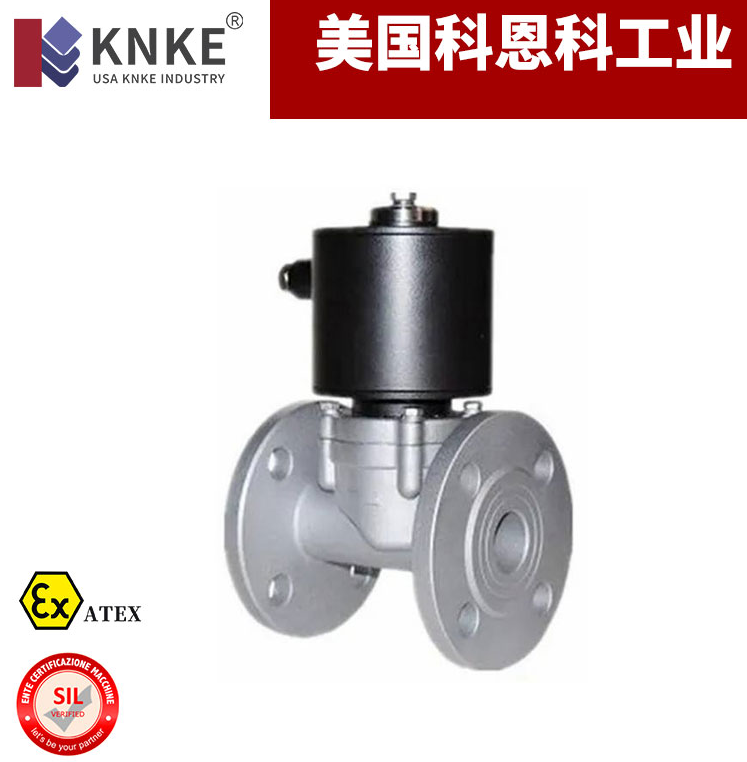
A pilot-operated solenoid valve mainly consists of two functional sections: the pilot valve and the main valve.
First, the pilot valve section sits at the top of the assembly. It includes the solenoid coil, armature, spring, and pilot orifice. Because the pilot valve moves over a short stroke, it requires only a small electromagnetic force. Consequently, it consumes less electrical power while still providing reliable control.
Next, the main valve section occupies the lower part of the valve and directly controls the main flow passage. Designers typically choose between two structures:
- Diaphragm-type main valves, which feature a simple design, low cost, and minimal wear;
- Piston-type main valves, which withstand higher pressures and perform well under high-frequency operation.
In addition, internal passages such as throttling orifices and balancing holes connect the pilot valve to the main valve. These passages play a critical role because they regulate pressure changes that enable main valve movement.
2. Basic Working Principle
The operating logic of a pilot-operated solenoid valve follows a clear sequence:
pilot actuation → pressure differential formation → main valve movement.
2.1 Energized State
When the solenoid coil receives power, it generates an electromagnetic force that lifts the armature and opens the pilot valve. Consequently, the medium inside the main valve chamber flows out through the pilot orifice toward the outlet or exhaust port.
At the same time, a small amount of medium continues to enter the chamber through the balancing hole. However, this inflow remains much smaller than the outflow. Therefore, the pressure inside the main valve chamber drops rapidly, while the pressure below the diaphragm or piston stays close to the inlet pressure.
As a result, the pressure difference lifts the diaphragm or piston upward. This movement opens the main valve and allows the medium to flow freely through the pipeline.
2.2 De-energized State
When the solenoid coil loses power, the electromagnetic force disappears. Immediately, the spring pushes the armature back to its original position and closes the pilot valve.
Because the pilot valve no longer releases medium, the pressure inside the main valve chamber starts to rise. Meanwhile, the inlet medium continues to enter the chamber through the balancing hole. Gradually, the pressure above and below the diaphragm or piston equalizes.
Consequently, the pressure differential vanishes. The main valve then closes quickly under its own weight and spring force, effectively stopping the flow of the medium.
3. Characteristics of Different Port Configurations
3.1 Pilot-Operated Two-Position Two-Way Solenoid Valve
This valve type includes one inlet and one outlet. Engineers mainly use it for simple on–off control of fluids. Because of its straightforward structure, it remains the most common pilot-operated solenoid valve and works well in both gas and liquid systems.
3.2 Pilot-Operated Two-Position Three-Way Solenoid Valve
Compared with a two-way valve, a two-position three-way solenoid valve adds an exhaust port. Therefore, it can switch between:
- connecting the inlet to the working port, and
- connecting the working port to the exhaust port.
For this reason, pneumatic control systems often use this valve type to achieve fast exhaust and reliable actuator reset.
3.3 Pilot-Operated Two-Position Four (Five)-Way Solenoid Valve
Engineers typically apply this valve type to control double-acting pneumatic cylinders. It usually features:
- one pressure inlet,
- two working ports, and
- one or two exhaust ports.
By energizing or de-energizing the solenoid coil, the valve alternates the supply and exhaust paths. Consequently, it controls the forward and reverse motion of the actuator efficiently.
4. Structural and Performance Advantages
Overall, pilot-operated solenoid valves provide several key advantages:
- They require low electromagnetic force and consume minimal power;
- They feature a compact structure and small installation footprint;
- They support a wide nominal diameter range (DN6–DN500);
- They perform reliably in medium- and high-pressure applications;
- They offer good versatility and convenient maintenance.
However, designers must consider one important limitation. Pilot-operated solenoid valves require a minimum pressure differential to operate correctly. Therefore, users should carefully evaluate system conditions when selecting valves for low-pressure or vacuum applications.
Pilot-operated solenoid valves achieve efficient and reliable fluid control by actively combining electromagnetic actuation with pressure differential principles. Moreover, their structural simplicity, energy efficiency, and broad applicability make them essential components in modern industrial automation and fluid control systems.